A comix.studio instrument
Speakers2.0
A cab that reacts to how you play — not a static snapshot.
A parametric guitar speaker cab that reacts to how you play — not a static snapshot, and not an AI emulation. Its own EQ and dynamics engine keeps your tone clear, natural and cohesive, however hard you dig in.
macOS 11+ · AU · VST3 · Standalone · perpetual licence
Free 7-day trial → buy once, unlocks forever · no subscription
Blind test
Same DI. Same amp.
One of them moves.
Toggle between a static cab IR and Speakers 2.0 on an identical signal. Watch the dynamics meter react to the playing while the IR sits still. Then download the lossless pack and A/B it blind in your own DAW.
Web playback is downscaled to AAC 256k for size — grab the lossless 48 kHz FLAC pack for a bit-exact A/B.
Why it's different
If an IR is a photograph,
this is the movie.
An impulse response is a fixed snapshot of a cab. Whether it's a tight 20 ms capture or a lush 500 ms "full-res" one, it replays the same response no matter how hard you dig in. Speakers 2.0 isn't a recording — it models the speaker itself, so it sags under power chords, blooms on sustained notes, and tightens when you ease off.
And it's not AI: no neural captures, none of the phasey, washed-out character those emulations carry. Just our own EQ and dynamics engine — so the tone follows your hands, not a file you loaded.
Try it — no install
Grab a knob. Watch it respond.
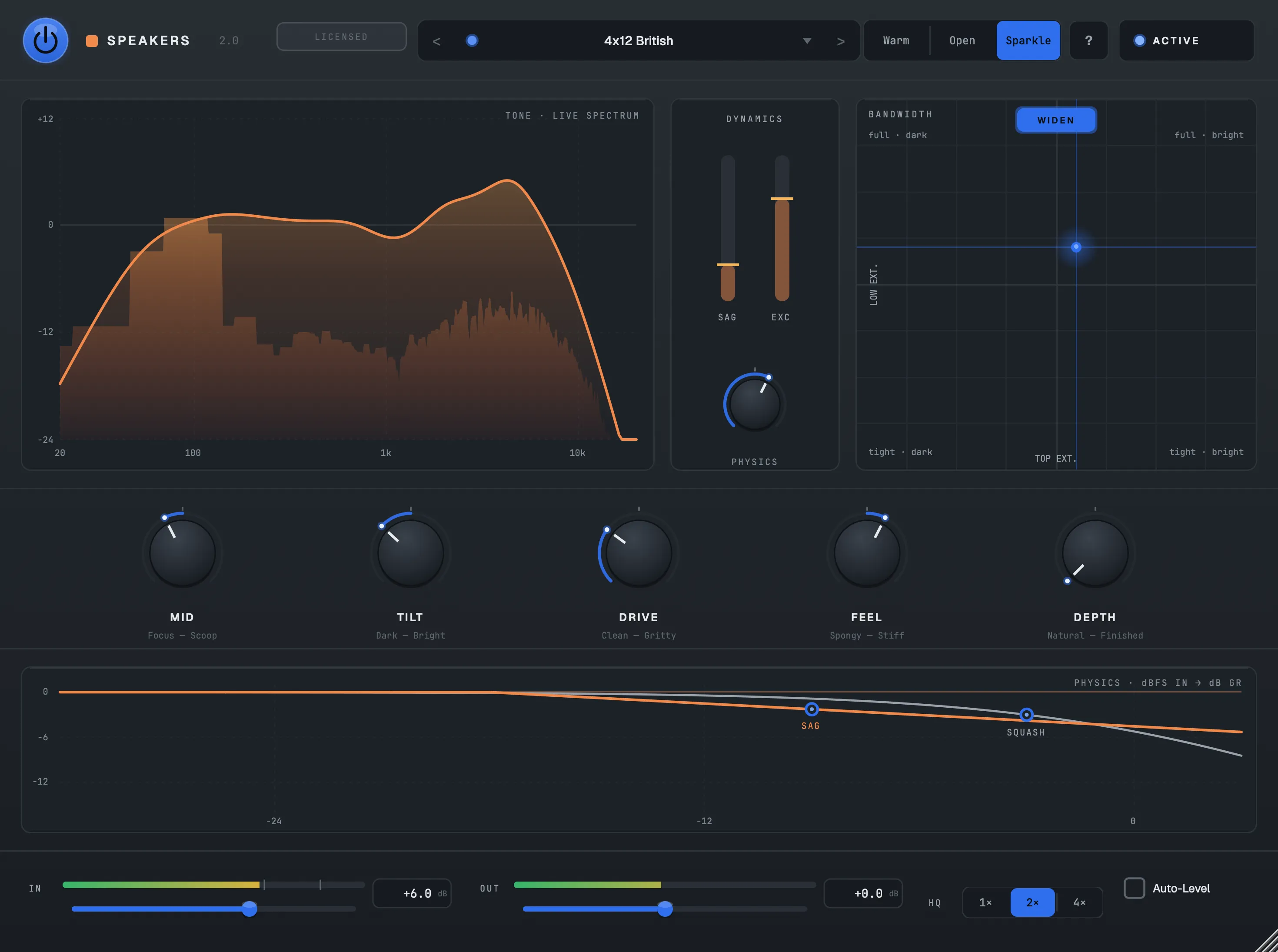
This is the real interface, running in your browser. Turn MID, tilt the tone, push DRIVE, set the FEEL from spongy to stiff, add DEPTH and switch the Air voicing — every move redraws the response curve live.
Visual demo · the real interface · hear it in the A/B above
Best on a laptop — open on a wider screen to drive it comfortably.
Five reasons
Built around feel, not a spec sheet.
-
Feel, not a freeze-frame
A physical cone-excursion model that sags, blooms and tightens with your dynamics. The cab reacts to your hands, in real time.
cone-excursion DSP
-
Not AI — our own engine
No neural captures, no phasey, washed-out artefacts. Just our own EQ and dynamics processing: band-limited from the ground up, with no fizz, whistle or wolf tones — only the part of the speaker you want to hear.
no AI · no fizz
-
One knob, dark → modern
Morph the cab archetype on a single axis, dark-and-woody to tight-and-modern, with zero menu-diving.
archetype morph
-
Tones that are yours
Parametric, not a cliché capture. Dial the speaker in your head instead of hunting for someone else's mic'd cab.
fully parametric
-
A real instrument, beautifully made
Graphite Console UI, a live tone curve, real-time spectrum and proper metering. Made by a guitarist who cared about the feel.
live curve + spectrum + metering
Start here
One pad. Every cab.
The X/Y pad is the first thing to reach for — and the fastest way to your sound.
Live — drag the node, or hit WIDEN.
It sets the cab's top- and low-end extension — in effect, the size and reach of the speaker. Sweeping around it is like having someone build you an endless run of custom cabs and speakers on demand: a touch more 3 kHz here, a lower resonance there, a tighter 1×10 — except every point on the pad is already voiced to sound cohesive and natural.
And because it sidesteps the problems of a real speaker and mic in a room, everything downstream gets clearer: your overdrive tightens and defines, and your reverbs and delays sit deeper, wider and cleaner.
Then shape the feel.
Once the pad has you in the right cab, four knobs refine the voicing and response.

- MID Focus — Scoop
- TILT Dark — Bright
- DRIVE Clean — Gritty
- FEEL Spongy — Stiff
Physics blends Cone, Squash and Sag · Auto-Level keeps volume matched as you tweak · HQ oversamples at 1× / 2× / 4×.
Eight starting points
Starting points, not destinations.
Eight presets to land you in the ballpark fast — then make them yours.
- Init
- 4×12 British
- Tweed Combo
- 2×12 American
- Modern Direct
- 1×8 Lo-Fi
- Bass Cab 4×10
- 4×12 Modern
Where it sits
It goes after your amp. Any amp.
Speakers 2.0 is the cab, not the amp. Drop it after whatever you already use — your amp sim, a free NAM capture, ToneX, or a real amp's DI through a load box. Use NAM for the amp; use Speakers 2.0 for the cab that actually moves.
- Guitar
- Amp sim / NAM / ToneX
- Speakers 2.0
- DAW
Pay once. Yours forever.
$59.
One payment — no subscription, no login wall, no "pro tier." Try it free for 7 days first: the download is the full plugin, and a licence key unlocks it for good.
- 1 Download the free trialthe full plugin — AU · VST3 · Standalone
- 2 Play it for 7 daysno card, no account
- 3 Buy once — unlocks foreverone licence key, same install
- AU · VST3 · Standalone (macOS 11+)
- 8 presets + a fully parametric engine
- Live curve, spectrum & metering
- One key · up to 3 machines
- Free updates across the 2.x line
- Free 7-day trial — no card needed
Perpetual licence · 3 machines per key · the trial simply goes silent after 7 days until a key unlocks it
- Neural DSP$119–199
- Two Notes GENOME~$80
- Speakers 2.0$59
Straight answers
No marketing fog.
Why not just use free NAM or a $20 IR pack?
Use them — Speakers 2.0 sits happily after a NAM amp capture. The difference is the cab: NAM captures and IR packs are static snapshots that sound identical whether you whisper or attack. Speakers 2.0 models the cone moving, so the cab responds to your dynamics the way a real one does. NAM for the amp; Speakers 2.0 for the cab that reacts.
Isn’t this just another cab sim?
A normal cab sim plays back a frozen impulse response. Speakers 2.0 runs a physical cone-excursion model in real time — it sags under power chords, blooms on sustain, and tightens when you ease off. Load the same IR a thousand times and it’s the same microsecond replayed; here the tone changes with how you play.
How is this different from “dynamic” cabs like DynIR, DSR or the OX?
Respect to all three — but they’re different animals. Two notes’ DynIR and Celestion’s DSR are captures: recordings of one specific speaker’s behaviour, replayed (DynIR per mic position, DSR including its nonlinearity). The UA OX is a hardware pedal. Speakers 2.0 is a parametric physical model — a cone simulation with real-time state and memory that you design with knobs, running after any amp, in your DAW, for $59. Don’t take our word for it: grab the blind test pack and listen.
Why $59?
Because it does something IR loaders don’t, and it’s still well under the rest of the shelf. Neural DSP plugins run $119–199; Two Notes GENOME is around $80. $59 buys a dynamic, parametric speaker engine outright — one payment, no subscription, no upsell. Not sure? The download is a free 7-day trial, so you can hear it in your own mix before you buy.
Do I need an IR pack too?
No. Speakers 2.0 is parametric — you dial the speaker instead of loading a file, so there’s no IR library to buy, manage or audition. Eight presets get you in the ballpark; four knobs and the X/Y pad take it the rest of the way.
Which DAWs and formats?
macOS 11 and up, as AU and VST3, plus a Standalone app. That covers Logic, Ableton Live, Reaper, Cubase, Studio One, GarageBand and anything else that hosts AU or VST3.
Is there a subscription?
No. One payment, perpetual licence, free updates across the whole 2.x line. No account required, no login wall, nothing to renew.
How many machines can I use it on?
Three at the same time — say your studio Mac, a laptop, and a live rig. One licence key activates up to 3 machines, and you can deactivate a machine from inside the plugin to free a seat for another. Lost or wiped a machine? Free its seat yourself at comix.studio/activations — just your key, no email needed.
Does it need an internet connection?
Barely. You need it once to activate your key; after that the plugin renews its offline licence with a quick background check every few days when a connection happens to be there. Each successful check buys three weeks of fully offline use — sessions, planes, studios with no network are all fine. Only if it can’t reach our server for about three weeks straight does audio pause until you reconnect once. The 7-day trial needs no connection at all, and when it ends the plugin simply goes silent (it never touches your sessions) until a key unlocks it.
Does it work after my amp sim / NAM / ToneX?
That’s exactly where it belongs. Speakers 2.0 is the cab stage — put it last in the chain, after your amp sim, NAM capture, ToneX, or a real amp’s DI through a load box. It replaces the cab/IR block, not the amp.